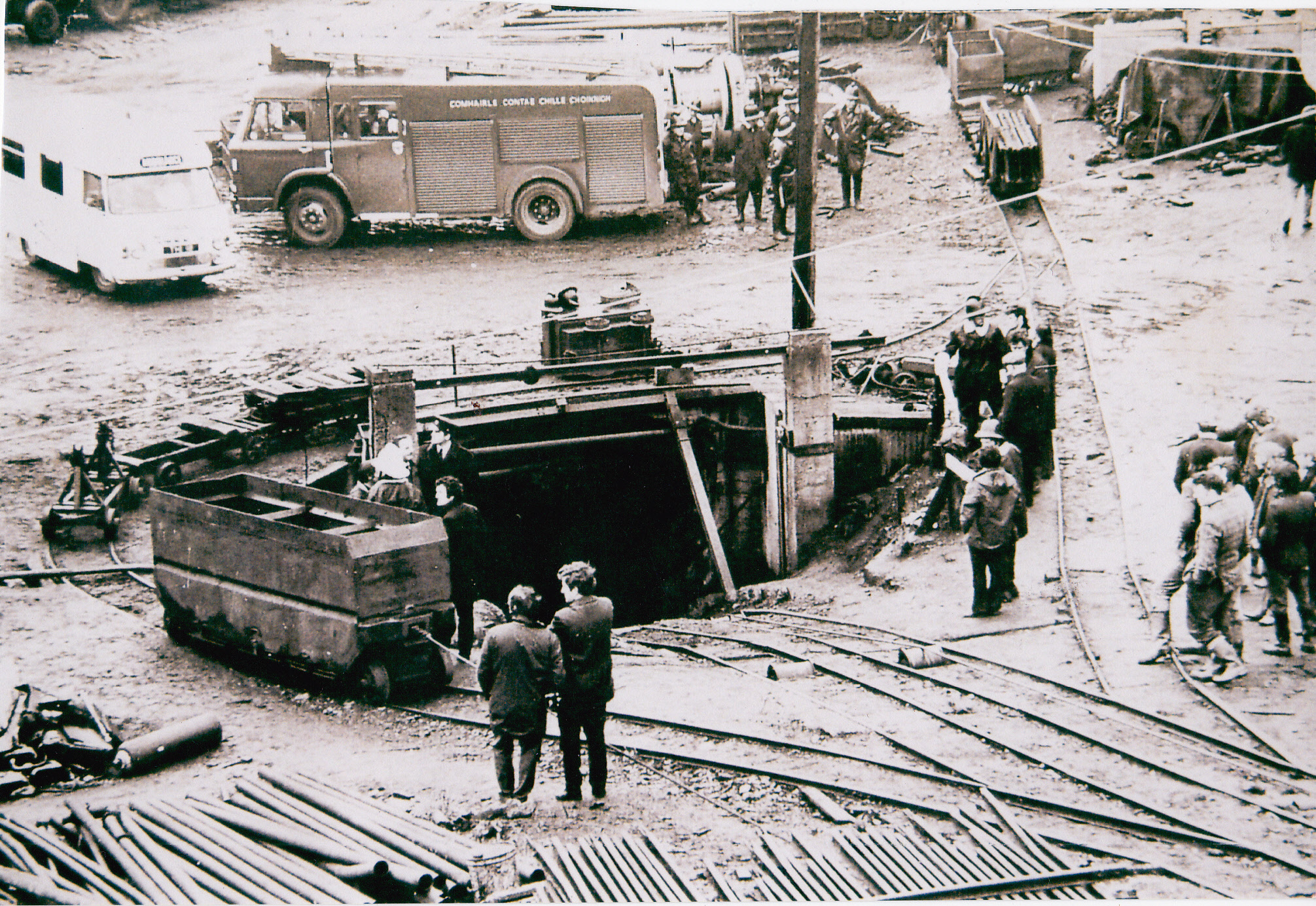
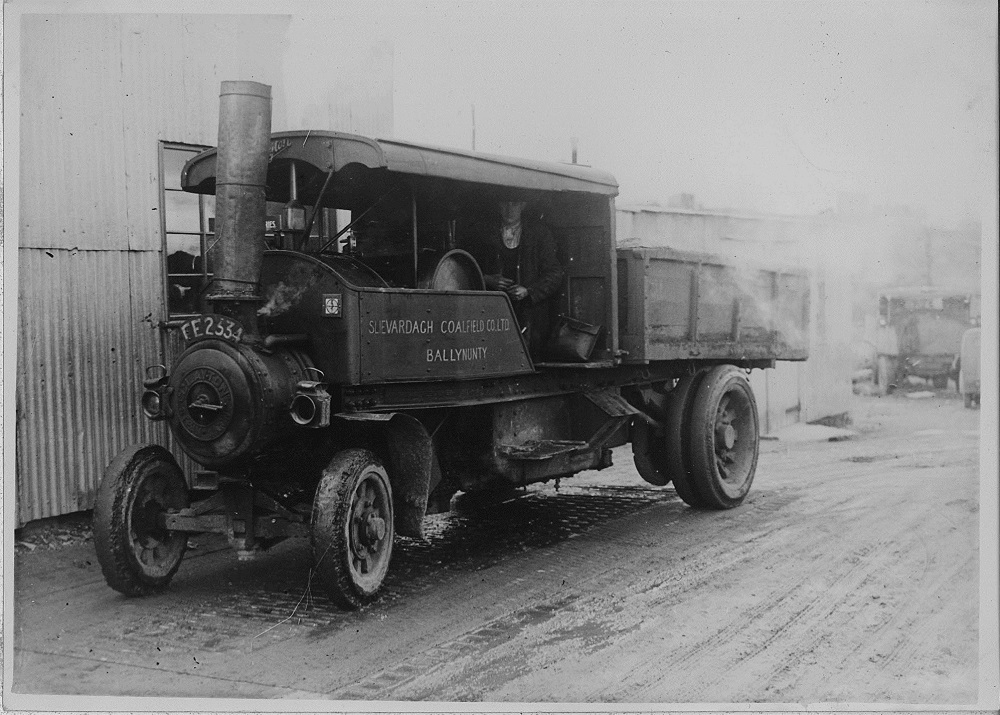
This week we are hoping that we can name more miners photographed in the 1940's. These men would have been born sometime between about 1900 and the 1920's. The photographs are taken by M A Keating for Mianraí Teoranta earliest date 1941 latest 1949. It is thought that they are most likely to have been taken in 1942 early in the the working of Ballynonty mine.
1940's Ballynonty 2nd from left Paddy Brennan
1940's Ballynonty 2nd from right Ned McGettigan
These two images are from the one photograph taken at Ballynonty. Paddy Brennan's daughter Magaret Brophy and Ned McGettigan's son Donie confirmed that these two men are their dads. This has us hoping that more men might be named.
We have no names for any of the men in the next two images, maybe you have wedding photographs of your parents or grandparents and you may recognise a face here.
Another photograph taken at Ballynonty with no man named
And the other half of the photograph above again with no names
We have got so used to taking lots of photos of people and taking selfies now-days that even artificial intelligence suggests which of your friends is in a photograph.
We still have no names for these miners from two generations
Even if you do not recognise any of these great men, you probably have photographs taken on film and printed on paper and probably nothing to do with mines or miners. Do your family a favour and name and date them for future generations.
And if you can name any of the men please let us know!
Removing Culm (graded coal) from a bunker under the Gantry at Gurteen
In Gurteen the miners extracted the coal and it came to the surface. Before it was sold it was cleaned of muck and stone and graded or sorted by size.
The coal came to the surface in the big skip and was emptied in one of two silos under the tracks in 'The Landing' (a big shed) and fed onto the first of three conveyor belts. It then moved onto the second belt to the 'Washery' where stones were removed by hand and the coal washed . On the third conveyor belt it traveled along the 'Gantry' to the 'Crusher' and on to the 'Grader'. The coal was graded by size.There were six bunkers for the graded produce- the first was for the few stones that had got past all the sorting and cleaning, then Culm or Duff, next the Grains, bigger Peas, bigger again- Beans and finally Nuts- the biggest coal.
The smallest produce culm or duff has a special history of use in household fires in the Slieveardagh area when made into Culm Balls.
In our blog about Mardyke Colliery 'duff' was mentioned in one of The Mining Company of Ireland's Reports from 1849. Seán O'Brien who grew up in Killenaule, read the blog and it reminded him that culm was marked on the dockets from Killenaule Creamery as duff. He wondered where the word duff for culm came from....
The Oxford dictionary states that duff is 'Coal in the form of small particles and dust: small coal, slack. Also duff coal.', it is not an Anglicised version of dubh (black) as it was also being used in Colliery reports in England.
Two references to Duff from the time of the working mines are:
In 1887 the Pall Mall Gazette informed the readers that 'One ton of common duff coal has generated as much steam as two tons of good bituminous coal.'
In 1925 H M Cadell's book The Rocks of West Lothian. An account of the Geological and Mining History of the West Lothian District. stated 'The mixed coal from the pit is now cleaned, washed, separated out and classified into round coal, 'nuts' of various sizes, 'pearls' and 'duff'
Collecting Coal from Ballynonty by Horse or Donkey and Cart
Seán shared his memories from the 1940's and 50's of the Slieveardagh coal mining area. He recalls purchasing Culm at Killenaule Creamery where it was marked on the docket as Duff, he also made 'a few trips for culm' directly to Ballynontymine with a donkey and cart loaned from Hanlys of Killenaule', and as he says 'Better still, with the same cart I went to the Ballinastick/Acres (?) area for Culm also, produced from a verticle shaft called a 'Basset''
Does anyone have a photograph of or more information on Hanleys of Killenaule or of anyone working the bassets in the Slieveardagh Coalfield
Locally Duff or Culm could be sourced from the collieries, collected from the streams and river banks where it was washed out from the mine workings and was also was a product of the much smaller Basset or Bell Pit Mines. There were basset mines across the Slieveardagh coalfield, they were usually family enterprises, much of what they mined was used in their own households or sold locally.
The duff or culm was mixed with Yellow Clay to make Culm Balls.Yellow Clay was found across the area, if a farmer had yellow clay on his land he would often allow other families to bring a cart of good clay to his land and exchange it for the useful yellow clay.
Most of the recorded history of mining and fuel production in the area is of the men who worked in the mines.
Culm ball were usually made during the Summer by hand or using a culm ball shooter. Families made the balls for their own use treading the mix, making the balls and drying them to store for the winter. If a horse was available a large quantity of culm and clay could be prepared by walking the horse on the mix.
After our early blogs Geraldine Healy commented 'as with every Heritage Project women have been airbrushed out' and I know they didn't go down the mines hacking away at seams but in Cornwall they had an important role in grading and sorting the product.' So unlike Cornwall there were no women working with coal at the mines in Slieveardagh, but many woman worked hard converting the otherwise nearly useless culm into Culm Balls.
Local Women spent the summers making culm balls for the next year. They would make them for their own use, and also work for other people. Presentation Convent in Ballingarry used Culm Balls as their main fuel and annually a large group of local women spent two full weeks making culm balls for the next year. Local landowners and big farmers also employed groups of women making culm balls.
Adding Yellow Clay to the Duff or Culm Heritage Week 2016
From Culm and Clay to Fuel: 'Dancing the Culm'
A ring of culm was spread on the ground and trampled down.
The yellow clay was dried and broken down to dust and added to the culm.
Water was gradually mixe into the pile to act as a binding agent.
The pile was 'danced' to mix the culm, yellow clay and water together.
The dancing continued till the mixture was very sticky.
Then it was made into culm balls, either by hand or using a culm ball shooter.
The balls were then fully dried in the open or beside the fire and stored.
Single, Double and 4-Ball Culm Ball Shooters
Finally today we have an excellent film made in 2017, Roisin O'Grady, Tipperary Heritage Officer is pleased to share this Story from the Slieveardagh Landscape .
Michael 'King' Cleere visits Slieveardagh National School, now known as 'The Old School' where he was a pupil, Lickfinn Mine where he worked, and finishes up in Glengoole at Buddy Brennan's Dancing the Culm.
This film is one from the series 'Stories from the Landscape' and was funded as an action of Tipperary Heritage plan by Tipperary County Council and the Heritage Council.
If anyone has any names of the women who worked making the Culm Balls for the Convent or others, or information or memories about their own basset mines or experiences of making Culm Balls please share them with us to add to our important mining history of the Slieveardagh Hills.
Tools from the Mines: Compressed Air 'Jigger' & Spanner
Today is the last day of Heritage Week 2021 where day by day we have brought you on a Virtual Field Trip of the Slieveardagh Coalfield. We have used a blog platform so everything we have put up and mostly shared through Facebook pages is there to stay and we plan to add to it. We have an interview with the last man down Foilacamin Shaft, and 'culm balls' and 'tallys' all to come soon.
We are revisiting the film T'was a Terrible Hard Work today, it was made in 2009.
This award winning short film animated and directed by David Quin is about coal mining in the Slieveardagh Coalfield. It features the voices of local miners Michael Heaphy, Tony Ivors, Nicholas Morrisey, Joe McEnery and Sean Lyons who shared some of the mining history and their memories. These men told these stories over a decade ago and this film is proof of the importance of continuing to collect and record our mining history. These men represent the mining community all of whom we wish to remember.
T'was a Terrible Hard Work Director David Quin 2009
And now our tour guide Michael 'King 'Cleere comes up out of the mines, but doesn't get past the local shop! Michael's interest in remembering and sharing the local history has educated and entertained groups since he lead our first Heritage Week tour in 2015. He still has more to tell...
There is always more to find out and we thank all the people who are following the blog and especially those who shared photographs and their memories during the week. If you come across any more history of the mines we can include it here.
Today our new messages include the memory 'miners as black as the coal, the miner who came to work for his brother, and the miner who locked the door on the last day and kept the key!
Thank you to Margaret Molloy who tells us 'Manys the evening I sat in the car waiting to see the wheel turning bringing up the Bogey out of the mines at (the) end of (the) shift full of miners as black as the coal.
Margaret's great visual memory is of Gurteen. The offices and car park were up a hill from mine yard so she could watch the winch wheel for it's movement knowing that the miners would soon be up and finished their shift.
Kelvin O'Brien's father Terence was one of Tommy O'Brien of Ballingarry Collieries Ltd. brothers. Along with his other brother Frank, Terence came over from St Helen's in England. Terence had become an experienced miner in Sutton Manor and Bold Colliery. Kelvin moved with his family to Clashduff at the age of two living there at the mine entrance until the family moved to Clonmel.Kelvin shared a picture of Terence taken when he was working in St Helen's
Terence O'Brien 1932 -1998
This picture reminds us that miners were young men, often 'going down' when they were as young as 14 years old.
And the Key.... Heritage week's theme is 'Open the Door to Heritage'!
Michael Moroney shared a fascinating story about a friend in Galway with an heirloom key.
'I have a friend who lives in Galway. His father, Tom Hickey, was from Ballingarry. His grandfather, also Tom Hickey, worked in the mines and on one of the occasions when the mines closed, his grandfather,Tom Hickey.... locked the door when it closed.
The big key with which his grandfather closed the mines hung above the fireplace in Galway for years afterwards.... and is still in the Hickey family.... Tom Hickey died about 1963, aged 83.
We don't know which mine he might have closed... Knockalonga in Coalbrook worked untill about 1910, so he would have been the right age to be working there. Ballingarry Coal Mining Company was working at Woodpit or Copper in 1898, again we don't know when it ceased operating so maybe Tom Hickey closed one or other of these mines. Do you know more about Tom Hickey?
And finally, if there are any miners wives or children (or miners, or their neighbours) who would be interested in sharing their memories and stories of the mining times, please contact us through either the blog or our Facebook page or at tippmines@gmail.com
We also want to collect and share more photographs, and record the names and dates of the Miners of the Slieveardagh Coalfield.
Underground in Lickfinn. Patrick Keating's son Michael revisits in 2013.
Lickfinn mine was worked in the 1940's and reopened in 1978 and was the last commercial mine in the Slieveardagh Coalfield
Lickfinn or Young's mine had been opened in the 1940's by Mianraí Teoranta.The ground had not been worked for over 30 years when Kealy Mines Ltd acquired the lease to that part of the coalfield and reopened the crank.
Irish Times 26th July 1979
Kealy Mines was established in 1978 by Patrick Keating and Gilbert Howley, it's name being a combination of their two surnames. Patrick Keating had previously worked for Tommy O'Brien. Gurteen had closed six months before the Oil Crisis and it was hoped that the reopening of mines in the area would not only bring employment but that the increased retail cost of coal would make it a profitable return to mining and bring some prosperity to the area.
Underground Lickfinn
30 years earlier Mianraí Teoranta had worked the No 2 seam. Kealy Mines were going much deeper to the No 1 seam seam. They employed 50 people.
They reopened the original one track crank or entrance used by Mianraí Teoranta and dug deeper to the 19th Century Lickfinn drainage adit (underground tunnel) that still exits at Ballynonty.
The old shaft or crank (Mianraí Teiranta's mine entrance) went down 700'. It's crank was about 40 degrees, while Gurteen's was much steeper at about 80 degrees.
It took six or seven months to clear the old shaft out and make it safe. Work started in 1978 and the men received £10 a shift and there were three shifts, the day, evening and back shift and the men changed shift each week.
Michael Morrissey was one of the miners employed, and he got an unusual task in the first phase of reopening the mine. He recalls the event for us:
'We cleaned up the crank 700' down and we met the tunnel, a level road, 'The Level' they call it.'
They met the Mining Company Of Ireland's Lickfinn Drainage Level or Adit, it used gravity flow to take the water away from the workings.The level still drains water from all across the coalfield. Lickfinn shaft is a couple of miles away from the mouth of the adit at Ballynonty.
Lickfinn/ Ballynonty/ Duggans Drainage Level or Adit
They broke through the adit, dammed it on both sides, piped the water and carried on down at 45 degrees and had gone another 40' when bad weather came bringing a huge volume of extra water. It came along the level and up and flowed over the dams. The water was only draining slowly down the level, and now with the extra volume it was building up and coming back.
Michael recalls 'we had three or four submersible pumps that pumped 10.000 gallons a minute- if you stood in front of it (the water) it would knock you.'
They made a 50' sump for the excess water but soon even with the help of the pumps it too was full.
'The underground staff said to the manager you'd be better off closing it down now and waiting for the good weather to come... It was going down slowly but it was blocked below at the level. There were breaks down in the level and no one could get to it so someone suggested I go down and come up through it, I had a good bit of experience with mining and was handy like, I'd fit through a place where a big lad would get caught.
So the next morning Michael Morrissey and his trusted friend Mickey Russell went on the mine lorry down to the adit or Duggans Level exit at Ballynonty.
We went into the level, and we went along and there was a big heap of stones down..... you'd get through, some of the O'Brien's men had got through, (at the time when Gurteen Mine was working) I could see where they had left their hand prints on the wall in the 'miar'- the stuff that comes off the water in a flood it was real yellow like mead. We had to plough through that for 2 miles ..... we got to the main breach and there was a rock down that I suppose was 30' long by 10' thick, it came down and shut the level off...
Michael realised that this was probably the blockage that was causing the water to back up at Lickfinn. The water meeting this rock had washed a deep shore or sump out behind it.
'I had a rope on me and Mickey was back about 30' just in case I walked into a sump or something- he'd have something to pull back on.'
So Mickey came up along and up onto the rock keeping hold of the rope and Michael went down into the water to the bottom of the sump.
'I went down to the bottom of it and there were five props in it, mining props.. road legs and they were about 7' or 8' long and they were stuck in the shore, the five of them wedged in holding the water, and I pulled them out and the last one I pulled out took me into the shore with the force of water, it was all built back up along... millions of gallons.... I caught the rope and I got out of it...
The roaring water going through the tunnel filled it to the roof, the men sat on the rock for about an hour and a halfrecovering and watching the water level go down. They then carried on clearing all the way up to Lickfinn. The water was hitting them in the face, Michael was caught at the back of his neck and in the chest but they ploughed on and eventually came out at the new opening at Lickfinn. Now the water went down the adit and away from the workings.
Mickey Russell and Michael Morrisey 2020
Michael says 'A badger wouldn't go up where we went but we had to stay going'
This extremely hazardous task was recalled by Michael Morrisey in the modest way and with the great visual memory that the miners from Slieveardagh Coalfield have. Mining was a very unsafe and difficult job, the men looked out for each other and every day their workplace brought more unknown dangers.
The water from the new working was pumped up just 260' to the adit and did not have to be pumped up 960' to the surface. The mine was worked by Kealy Mines up until 1982, when the cost of pumping and the high proportion of duff or poor quality of coal used up their remaining capital and they ceased working the coalfield.
Michael 'King' Cleere worked here and describes how excess water got into the mine workings, and the problems it caused.
Flair Resources, a Canadian based public company trading as Tipperary Anthricite Ltd bough up the operation hoping that the rising cost of anthricite caused by the Oil Crisis would yield them good profits. Coal cost £10 a ton in 1971 rising to £160 a ton in 1982.
By 1983 80 people had been employed with the help of IDA funding, but flooding was becoming a major problem, and weeks were lost in down time. Their pumping equipment did not match the volume of water entering the mine. In December 1983 Tipperary Anthricite went into liquidation, Flair Resources following in 1985. Large debts were left behind and and enquiry was established to examine it's commercial and financial state of affairs.
Detail of Lickfinn Yard Plan 1985
In 1989 Emerald Resources acquired a State Mining Lease for 602 ha of the Slieveardagh Coalfield. The lease was for 20 years and they were based at Gurteen but after 2 years they were gone, ending any further commercial mining in Tipperary.
All the mine sites are on private property and are not open to the public. Annually during Heritage Week our Mining Interest Group have sought permission from the landowners to visit. Derelict buildings can be dangerous, please do not trespass.
Gurteen Mine, Ballingarry Colliery provided work for men from the whole Slieveardagh area
Tommy O'Brien purchased the mining rights to the Slieveardagh Coalfield in 1952, he worked the mine at Clashduff until 1957 when he moved the operations to Gurteen, working there till 1973.
Tommy O'Brien's Ballingarry Colliery started in Clashduff and then moved to Gurteen
The Clock house
In the 1960's there were 360 men working underground at Gurteen.
There was a day shift and an evening shift. Compressed air was piped underground to operate the equipment the miners used, it also provided some ventilation for the miners and there were air shafts with fans to help draw away the bad air. The only safety equipment the miners had were their helmets and battery operated lamps, otherwise they provided their own boots and clothing. The lamps were a big improvement on the old carbide lamps as the batteries would last a shift and did not go out unexpectedly.
Gurteen 'Topside' Model 2018 The Old School Mining Museum
There were many more men working above ground or 'Topside'.These men and a very few women (working in the offices and at the weighbridge) supported the miners underground
Jobs above ground included
working in the office and weighbridge,
in the lamp house where the batteries for the lamps were charged between shifts,
at the saw house preparing wood for use underground,
on the landing where the tubs or skip of coal or were emptied,
the washery where the coal was cleaned of mud and stones were removed,
the gantry where the coal was graded,
the bagging yard, and then there was
the compressor house, and the electrics and fitters stores,
the oil shed, the garage,
the boiler house and
there were men who drove the tractors, loaders and dumpers around the site and also delivery lorries and the mine bus.
Gurteen was a big operation when it was working .
Gurteen site taken from the 'bank' in 2013 by Gerry Clear
The mining stopped at Gurteen in 1972, but the yard was used for storage and grading up until the end of mining in the coalfield in 1989.
Change of Shift
The miners had to walk down the crank or mine entrance at the start of their shift.
Underground, in the mine they might have to walk more than a mile before they reached where they were working. The underground roads from Gurteen crank ran underground as far as the colliery at Earlshill. So the miners would take food down with them and have their breaks underground and not return to the surface until the end of the shift. There were small tubs or bogies that they would come back up in at the end of the shift.
Michael 'King' Cleere tell us about the history of and developments in Gurteen Mine.
Tragedy in Gurteen Mine
The six miners who were trapped underground when the mine flooded in 1964
In 1964 mine manager Mr Gannon was trapped and drowned when the mine was breached by water from old mine workings.
Electrician Christy Lawlor was manning the pumps at Foilacamin, an old 19th century mine with a vertical shaft. The water was continually pumped up and out of the workings, and when the breach happened the water stopped coming up from the pump and he rang over to the mines alerting them to the incident.
Michael Hanrahan was one of the trapped miners that night.
They had been underground since 4.30 and at about 8.30 the miners congregated together and stopped for their tea and sandwiches, Mr Gannon was the manager on the evening shift and along with Tony Joy and Ned Hayes had a break with the others before going to see where the water was seeping through.
Michael and his brother Danny went back to where they were working, Michael was up the 'topple', (the miners worked up into the seam so the coal could be dropped by gravity to the underground roads below) when there was a sudden bang and 'smoke' or dust. The whole road below them was flooded.
Jim Maher, Jimmy Lawlor and fireman Michael Heaphy (a fireman was a miner who set the explosive charges to blast into new area of the mine) were also working above that road and managed to join the Hanrahans up where they were working.
The road below had fallen in, and the water was backed up. Michael says they were in dread that the water would hit the roof and cut off the air but they did still have the air from the compressors they had on their machines. They thought they were doomed and said their prayers, and waited.
After some hours they heard noise. Miners not involved in the incident had managed to let off some of the water and the trapped group were able to escape by holding onto the pipes and climbing over the debris from the fallen road to safety.
When the water had breached the workings Mr Gannon, Tony Joy and Ned Hayes were washed along in the water, tragically Mr Gannon did not survive and was drowned. Ned Hayes was never included in the newspaper reports, but that evening he saved Tony Joy's life. Tony had been washed to a timber behind the road and Ned pulled him out.
Michael says although the incident was devastating in the area they were working, there would never have been enough water to flood the whole of Gurteen as there was so much ground open.
He finished recalling the evening with 'If no one had to go up the road that night there would have been nobody lost'.
Michael and his brother Danny are the only two men involved in the flooding that night that are still alive.
Patrick and Gladys Lydon interview the '4 Michaels', Michael Hanrahan on the right.
Michael generously recalled this terrifying and traumatic incident for Patrick Lydon in an interview in 2020 for Suir Vision a project Patrick co-ordinated on stories about the water that feeds the Suir river.
Recievership of Ballingarry Collieries
RTE covered the day the mine went into receivership.
Wally Mackey spoke to RTE that day and has collected and shared many excellent photographs and articles on Gurteen mine over the years. The television report can be viewed in the RTE online archive. (https://www.rte.ie/archives/2017/0921/906472-ballingarry-coal-mines-to-close/)
Fire Underground
Philip Butler shared this newspaper cutting about the underground fire at Gurteen
The last major incident at Gurteen reported on was the underground fire in 1973.
All the mine sites are on private property and are not open to the public. Annually during Heritage Week our Mining Interest Group have sought permission from the landowners to visit. Derelict buildings can be dangerous, please do not trespass.
If you have any photographs or memories of Gurteen Mine please share them with us so they may be recorded as part of this important Tipperary Coalmining History.
Mianraí Teoranta (Irish for, literally, “Mines,
Limited”) was established as a semi-State company in 1941. The company acquired rights to mine coal in
Slieveardagh in 1941, selling the rights on in 1952.
Mianraí Teoranta opened mines first in Ballynonty and Lickfinn and later in Ballingarry
There is only the spoil heap (stone taken out of the ground to reach the coal and piled on the surface) and the ruins of the managers house still at the Ballynonty mine site.
Ruin of the 1940's manager's house at Ballynonty Colliery
The Mine Manager was Scottish engineer Mr McGlucky
During 1941 and 1942 the development of Ballynonty Mine was documented by Clonmel photographer M A Keeting. But for this we would have little recorded history of this era of mining in the area.
No 1 Mine, Office and Compressor House 18th February 1942
Office and Weighbridge November 1941
Transporting Temporary Buildings November 1941
This semi-State company was formed five years before Bord na Móna which also provided employment in the Ballynonty area. Both Ballynonty and Lickfinn or Young’s Mine were worked during the War
Years, but by 1948 these had become uneconomic. The whole operation then moved to the Copper Basin in Ballingarry
M A Keating also recorded the opening of the mine in Copper Basin in 1948.
Ballingarry (Copper/Clashduff) Concreting entry 8th December 1948
Ballingarry Concreting completed 31st December 1948
Ballingarry October 1948
Today Michael 'King' Cleere visits the site of a mine opened in 1941 by semi-state company Mianraí Teoranta and then moves on as they did to Clashduff.
Did any of your relations or neighbours work in Ballynonty in the 1940's?
We are collecting the names of families or men who worked in Ballynonty in the 1940's, as there is very little documented information on who worked there.
Miners at Ballynonty, Slieveardagh Coalfield used carbide lamps.
We posted a photograph of two miners whom we believe worked at Ballynonty.
Both Joe Hennessy and Paddy Robinson asked does anyone know the names of these two miners, we would like to be able to name these men too.
The photograph is an important historic record as right up till the 1960's many of our miners started working in the mines when they were 14, working alongside their fathers or older family members.
Any names for any of these men too please?
More miners photographed by M A Keating
M A Keating also took this photograph
We can be messaged publicly in the comments box at the end of each blog post, or through Facebook. We also have an email address tippmines@gmail.com if you have any names photographs, memories or stories to share about the mines from this time.
This is part of our really important local and mining heritage, if you are related to or knew someone who worked for Mianraí Teoranta please can you send us on their name and dates so we can record them for the future. We would also like to add any photographs of these men and their families to our resource of the local mining history.
Thank you to Gerry Clear who visited the Slieveardagh Coalfield with the Mining Heritage Trust in2013. He has sent us a collection of the photographs he took that day.
Broomhill 2013 Michael Hanrahan and visitors
Broomhill - getting a better look at the tunnel driven into the hill
All the mine sites are on private property and are not open to the public. Annually during Heritage Week our Mining Interest Group have sought permission from the landowners to visit. Derelict buildings can be dangerous, please do not trespass.
2013 Mining Heritage Trust of Ireland Field Trip. Leader Phelim Lally
Slieveardagh Coalfield's Landmark Structure
This is a chinmey built in 1863, it is neither a steeple nor has anything to do with the mineral copper. It is in the townland of Copper. Ballingarry
Base of the chimney showing the quality of the stonework and skill of the stone masons
It was built by local stone masons Edward and Michael Kenny fromCurraheenduff, Coalbrook. They were known as 'Kennys the Masons'.
The chimney is four sided and is 96' or 29.3 meters tall. The east and west faces of the chimney have arched entrances to it's interior where a furnace would have been installed.
Today Michael 'King' Cleere visits Copper Steeple and shares it's surprising history.
There ground is solid below the chimney, no shaft was ever dug and there is no soot or burn marks on the interior of the chimney so no fire was ever lit.
The chimney was to be a ventilation shaft for the mines below the ground. Ventilation shafts worked like house chimneys. There would be a furnace inside the base of the chimney and a fire was kept lit in it.
The hot air from the fire
would rise
create a draught
draw up the impure air from the mine workings below
Here is a short video using paper cutouts to show how a ventilation shaft works
All the mine sites are on private property and are not open to the public. Annually during Heritage Week our Mining Interest Group have sought permission from the landowners to visit. Derelict buildings can be dangerous, please do not trespass.